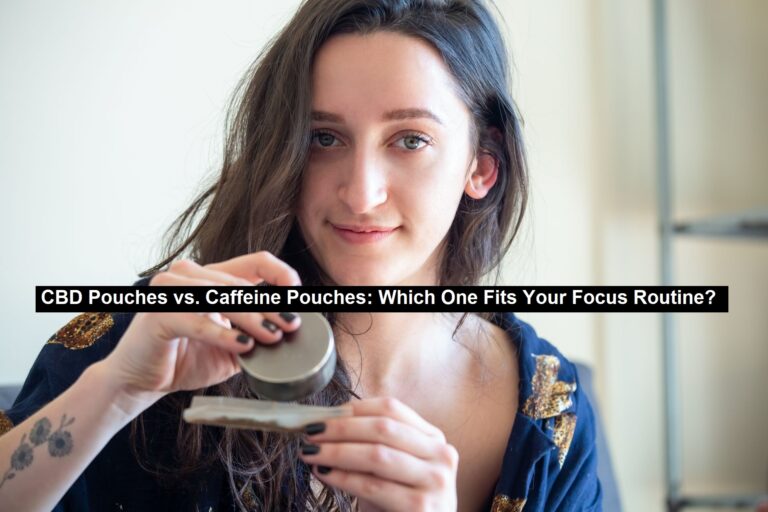
CBD pouches and caffeine pouches end up on the same shelf. Both are nicotine-free and both get sold as something to reach for before a long afternoon. They do nearly opposite jobs. Caffeine is a stimulant with a known dose and a predictable effect: it makes you more alert. CBD doesn’t intoxicate, its human research is thinner, and most people who buy it want to take the edge off rather than sharpen up. Which one fits depends on your 2 p.m. problem. Are you tired, or wound up?
I make a caffeine pouch, so weigh what follows accordingly. Our own lab results are in here too, including where we came in under our label.
What each pouch actually delivers
A caffeine pouch is a measured dose of caffeine that sits under your lip. Ours lists 50 mg per pouch, from guarana. For scale, the USDA puts an 8 oz cup of brewed coffee at about 95 mg, so one pouch is roughly half a cup. Caffeine works by blocking adenosine, the chemical signal that builds up during the day and makes you feel tired. That mechanism has been studied for decades.
A CBD pouch delivers cannabidiol, the non-intoxicating compound in hemp. It doesn’t work the way caffeine does, and how it acts in the body is still being worked out. The human trial cited most often for anxiety is a 2011 study in Neuropsychopharmacology (Bergamaschi et al.). It gave 600 mg of CBD to people with social anxiety disorder before a simulated public-speaking test, and they reported less anxiety than the placebo group. That’s a real result. It was also small, with 12 patients on CBD, and the authors called it preliminary. 600 mg is a large dose, so compare it with the milligrams printed on the pouch you’re considering.
Side by side
| Caffeine pouch | CBD pouch | |
| What people use it for | Alertness, getting started | Winding down, taking the edge off |
| Evidence at the dose you’re buying | Strong; caffeine’s dose-response is well described | Limited; the best-known anxiety trial used 600 mg |
| Federal status | Caffeine is a lawful dietary supplement ingredient | FDA’s position is that CBD can’t be sold as a dietary supplement, though CBD products are widely sold anyway. Its only approved CBD drug is Epidiolex, for certain seizure disorders |
| How long it lingers | Half-life averages around five hours in healthy adults, and runs longer for some people | Varies widely by dose and route; pouch-specific data is scarce |
| Main thing to watch | Sleep, jitters, stacking it on top of coffee | Drug interactions, label accuracy, trace THC |
The FDA cites 400 mg of caffeine a day as an amount not generally associated with negative effects for most adults. That figure counts every source together: coffee, soda, pre-workout, pouches.
The label problem both categories share
This is where the two shelves look most alike. Neither label is a guarantee.
For CBD, the study people still point to is Bonn-Miller et al., published in JAMA in 2017. Researchers bought 84 CBD oils, tinctures and vape liquids online and tested them. About 31% were labeled accurately. Around 43% held less CBD than the label claimed and 26% held more. THC turned up in 18 of the 84. They didn’t test pouches, but it’s still the best-known label audit in the category.
Caffeine pouches can drift too, and I can show you ours. Our label says 50 mg. When Certified Laboratories in Burbank ran lot 202605 by HPLC, it measured 39 mg in Mint, 40 in Cinnamon, 44 in Peach and 48 in Wintergreen. All four flavors came in under the label, and Mint was about a fifth short. That certificate sits on our lab-testing page next to our vape results, short numbers included.
Whichever pouch you buy, the check is the same. Ask for a certificate of analysis (COA) from a named, independent lab. Make sure it matches the lot you’re holding and covers your flavor, not one hero product. For CBD, look for a THC line with an actual number or a stated detection limit, not a blank.
That THC line is about to matter more. Congress rewrote the federal definition of hemp in November 2025, capping finished hemp products at 0.4 mg of total THC per container. After a delay passed in September 2026, that cap is scheduled to take effect on December 11, 2026. Full-spectrum CBD is the type most likely to be affected. If that’s what you buy, check the current rules and the THC number on the COA before you stock up.
Read: Benefits, Nutritional Value, Side Effects, And Dosage Of Hemp Seeds
Which one fits your focus routine
Tired, foggy, can’t get started. That’s the problem caffeine was built for. A pouch is a smaller dose than a large coffee, and you can stop at one.
Already wired, or three coffees deep. More caffeine makes this worse, and this is when people reach for CBD. The evidence at pouch-sized doses is weak, so go by how you actually feel after a week rather than by the claims on the tin.
It’s 3 p.m. and you want to sleep tonight. Watch the clock. In a 2013 study in the Journal of Clinical Sleep Medicine (Drake et al.), 400 mg of caffeine taken six hours before bed significantly cut total sleep time. A 50 mg pouch is an eighth of that dose and wasn’t tested, but the timing logic carries over: the later you take it, the more is still in your system at bedtime.
You take prescription medication. The FDA says CBD can change how other medicines work, and that other medicines can change how much CBD is safe to take. Tell a pharmacist about any CBD you use. Caffeine has interactions of its own.
You’re pregnant or breastfeeding. The FDA strongly advises against CBD during pregnancy and breastfeeding. Caffeine guidance is tighter too: ACOG puts the limit at 200 mg a day.
Some people use both at different times of day. We haven’t tested the two together and won’t pretend to know how they combine. If you’re curious, try one at a time first, so you can tell which one is doing what.
Where our pouches fit
Our caffeine pouches pair that guarana caffeine with a botanical blend of phosphatidylserine, ashwagandha, reishi, lion’s mane, cordyceps and bacopa. The caffeine is what you’ll feel. We don’t claim any one of the botanicals does something specific at these amounts, and a brand that makes that kind of claim should be able to show you the study. They come 20 to a tin for $9.99, they’re sold as a dietary supplement for adults, and they contain soy.
If your afternoon problem is low energy, caffeine fits, and a 50 mg pouch is one easy way to take it. If the problem is too much energy, more caffeine won’t help, and the CBD label deserves the same scrutiny as ours.
Conrad Kurth is the founder of Cyclone Pods, which makes nicotine-free vapes and caffeine pouches. Lot 202605 of its pouches was tested by Certified Laboratories (Burbank, CA).